An October 2025 Interview with Pierre-Alain Giraud, writer/director of 'Playing with Fire: An Immersive Odyssey with Yuja Wang'
Samantha King
In conversation with Samantha King, Head of Programme, VIVE Arts
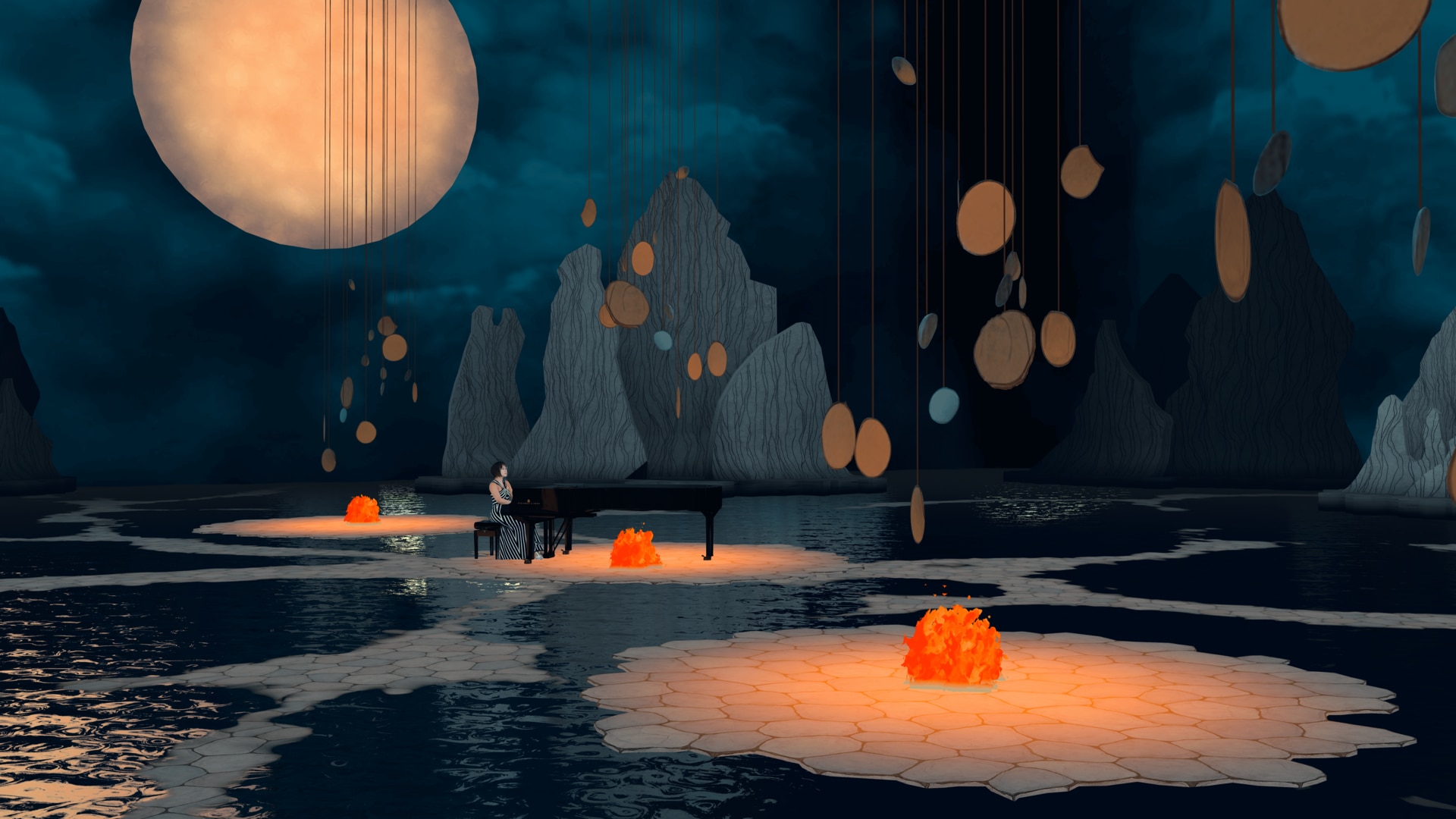
VR still, Playing with Fire: An Immersive Odyssey with Yuja Wang, written and directed by Pierre-Alain Giraud, 2025, courtesy of VIVE Arts and Atlas V.
Let’s start with an introduction. Can you tell us about your path into directing and the field of immersive arts?
I started as an engineer first. I did a master’s in engineering in France—five years of study including three years at l’École des Arts et Metiers. I finished in 2005, and got a job at the French Embassy in Iceland for two years as Cultural and Scientific Attaché. They were looking for an engineer because there was a significant scientific component to the role. I managed to convince them to let me program a major French festival in Iceland. I got to work with all the artists I loved at the time, including Gabríela Friðriksdóttir (who created the original artwork and co-creative director for Playing with Fire). I invited the M/M (Paris) artists to collaborate with her on a monumental bronze tree sculpture that’s still standing in Iceland. We managed to get Air, Daft Punk, the composers Johann Johannson, Valgeir Sigurðsson, and various French writers or theatre directors like Arthur Nauzyciel. It was a formative time where I met lots of artists who would later become collaborators and friends.
After Iceland, I studied filmmaking at the London Film School from 2019. I liked being an engineer, but I always knew I wanted to make films and use what I learned as an engineer to create different kinds of work. That’s how I began working with immersive mediums. There’s a different presence in immersive—it’s between theater and film. I’ve always been interested in trying to find the right shape and technologies for the stories I want to tell. From the beginning, I was interested in breaking traditional narrative structures. My first film was about a guy trapped in a black-and-white movie trying to get out of it. It was called I've Been Trapped in a Black and White Film. Very literal! My next film also explored this idea of breaking the frame. Then I spent time working in theatre, creating films to be projected on stage. I also acted from a very young age—from about five years old. My father was a teacher and my mother worked in a library, so I grew up surrounded by books and performance.
Was there anything from your childhood that particularly influenced your interest in this work?
We went to see films at the cinema and to the circus a lot when I was young. Chaplin is one of my biggest references. I love The Kid. For me, it’s a perfect film. Chaplin came from the circus. A lot of the early moving-image films either featured or were shown at circuses. Chaplin’s films have had a great influence on my work.
Something that was also really formative for me was that I couldn’t have a television until I was about fifteen. But we did have a small film projector—8mm—in the middle of our living room where we’d watch silent films: Harold Lloyd, Chaplin, Laurel and Hardy. I could see and hear my parents behind the projector, moving around in the space but the sounds would be coming from them and not the films. This image of the projector in the centre of the living room, with life happening around it, has always stayed with me.
That’s a very vivid image. What was your first immersive project?
My first immersive work was Solastalgia (2019), that I created with Antoine Viviani. We wanted to tell a post-apocalyptic story with ghosts—where humans had recorded themselves in a giant machine to live forever on earth. The HoloLens had just come out, and it was like the realisation of what we had in mind. We could see ghosts. I gathered a team for that project that I still work with now. My engineering skills were also very handy to enhance the use of the device. Then it was COVID and we had to stop touring it.
At the same time, I was working with Tania de Montaigne and Stéphane Foenkinos on a theatre project called Noire. I thought it would be the perfect story to also explore in this immersive format. I met Stéphane through Arthur Nauzyciel when working on a Korean play called The Empire of Light (2019). We opened it in South Korea, then toured in France. Stéphane saw the play and asked if I wanted to work with him on putting on stage the book of Tania called Noire. The immersive exhibition opened in 2023 at the Pompidou Center and got a success we would never have expected and is still touring now.
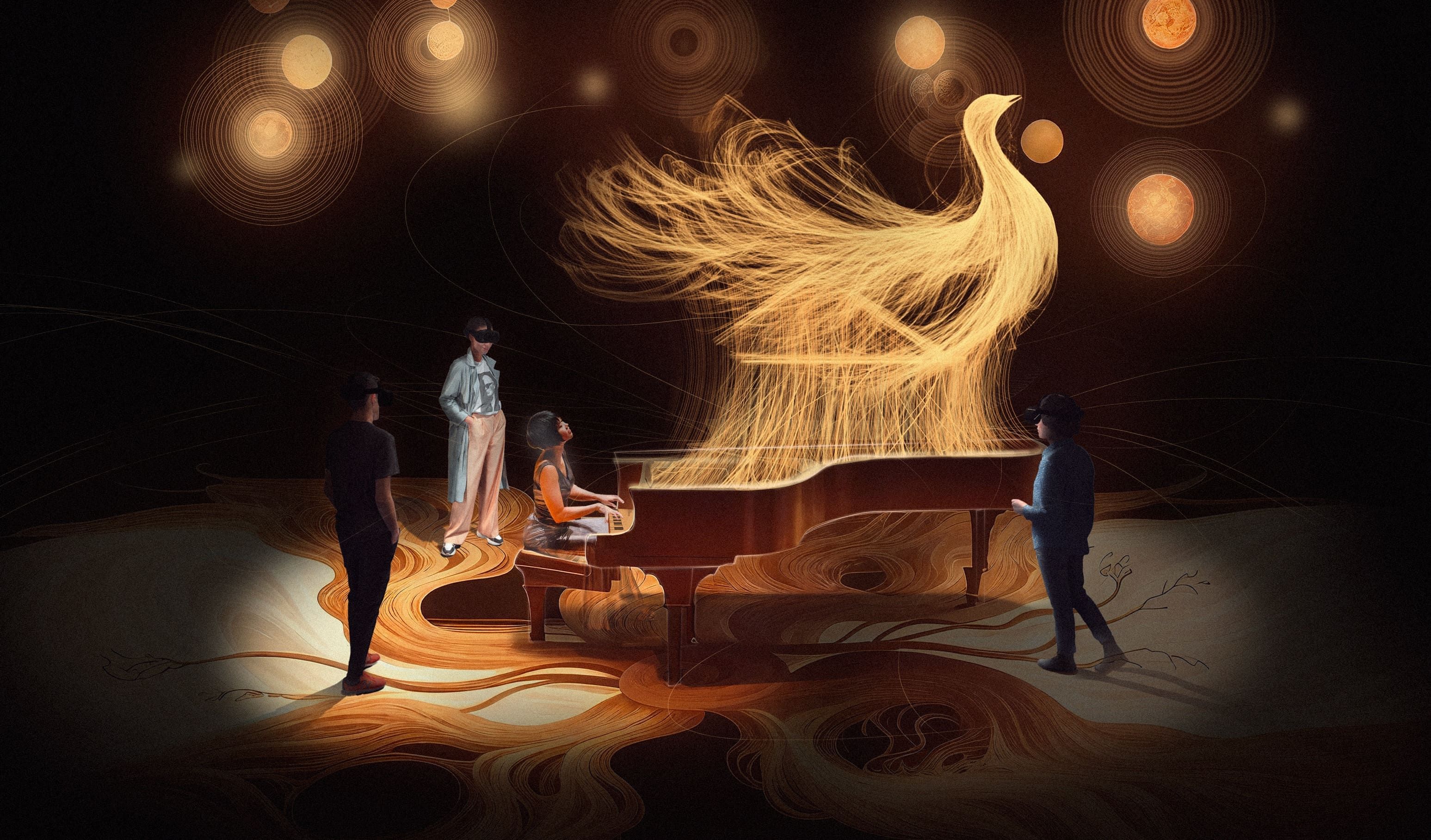
Early rendering of Playing with Fire installation (3D sketch). Graphics with AI / Clément Deneux.
And to Playing with Fire. Can you describe its origin story—how you came to this project and the collaboration with Yuja?
I was already a huge fan of Yuja Wang. My friend, a philosopher and musicologist called Dominique Pagani, introduced me to her work a long time ago. He’s 80 now. He’s listened to everything. He told me, “For me, there has never existed someone who is so good—technically and musically.” This was when Yuja was probably just 25.
She has this way of playing that’s somehow so humble. She’s flamboyant and fierce, but when she’s in the music, she’s really focused, really in the composer’s mind. She doesn’t over-express like other musicians can. She has this respect for the music that I find remarkable. I started listening to classical music much more deeply thanks to her.
When we were doing Noire at the Centre Pompidou, she was performing in Paris with a friend of mine, Nico Muhly, who had composed pieces for her. I was at her concert with Valgeir Sigurðsson, and I thought, “I would love to have her come see Noire, I’d love to work with her”, but I couldn't make it work. Then we were showing Noire in Cannes, and Antoine Cayrol from Atlas V called me. I remember the exact moment. I was in a parking lot in Toulon, getting into my rental car to drive to Cannes. He said, “Do you know Yuja Wang?” I told him I'd never seen anyone in concert more times than her. Then he told me about the mixed reality project they were producing with VIVE Arts and asked if I’d be interested in directing it. Of course I said yes!
How did the artistic vision of the project come into being? What were the early inspiration prompts for you, beyond of course collaborating with Yuja?
I talked with Dominique, my philosopher friend, and thought it would be good to use fire as a theme. I wanted something that would start with Yuja. Fire is the human element that represents progress—from Prometheus through the whole history of humanity. It’s been a defining element of what it means to be human. And Yuja embodies that fierceness. She’s always described as fiery. There’s this huge flame on stage when she performs.
Fire is a very dual element; it can be as good as it can be dangerous. It has this in-betweenness that’s really interesting. And it’s been expressed in music, particularly from the 19th century onward. I read Gaston Bachelard's The Psychoanalysis of Fire and started thinking about which pieces of music could show all the typologies of fire and everything fire can express—from homey, comforting fire to holy fire to the fire of wars, cannons, and destruction. Bachelard references this beautiful line from a poem by Novalis: “Water is a wet flame”, which depicts very well the union of opposites, creating new symbolic realities. We actually start our fire journey with Ravel’s Jeux d’eau (which means “playing with water”). The fire starts from that source of life in the depths of the sea.
When did you first meet with Yuja to discuss the project?
We first met in person in June 2024. I was really nervous because I had the beginnings of this idea and I had to present it to her. But I think she liked it, and she started having ideas about the possible pieces too. There were things I proposed that she didn’t like at all, pieces she wouldn’t play. But some she really liked, and then she proposed other ideas. It was a lot of back and forth—finding a story through music. Through that process we got to know each other quite well, and I think a deep trust and friendship came out of this. The pieces we chose are well balanced. There are explosive moments like Stravinsky’s Firebird or Prokofiev’s War Sonata, and then more classical French music like Debussy and Ravel, which represents this in-between Impressionists moment when for the first time artists were describing impressions through art.
Richard Slaney, the CEO of Lightroom was also a big help in that process. He had invited Yuja to perform inside the immersive exhibition at Lightroom in London David Hockney: Bigger & Closer (not smaller & further away) in September 2024. Lightroom also conceived and produced the shoot of Yuja performing the repertoire from Playing with Fire on a Steinway Spirio piano shortly after that. So because of timing, we discussed the program together to find something coherent for both the Lightroom Hockney show and our project.
Did you discuss with Yuja what she visualises while she’s playing?
Actually, we didn’t speak that much about what she imagines visually. We spoke about the music and what it evoked for her, how she liked to play some pieces and didn’t like to play others. It was very interesting to know the relationship between her and the composers she was playing—like her love-hate relationship with Liszt, how she speaks about this “sadistic temptation” for pianists, and how she sometimes hates playing some Liszt pieces. But when she plays them, it’s so natural that it’s difficult to imagine it’s been painful for her. They’re devilish pieces, impossible to play, but she masters them.
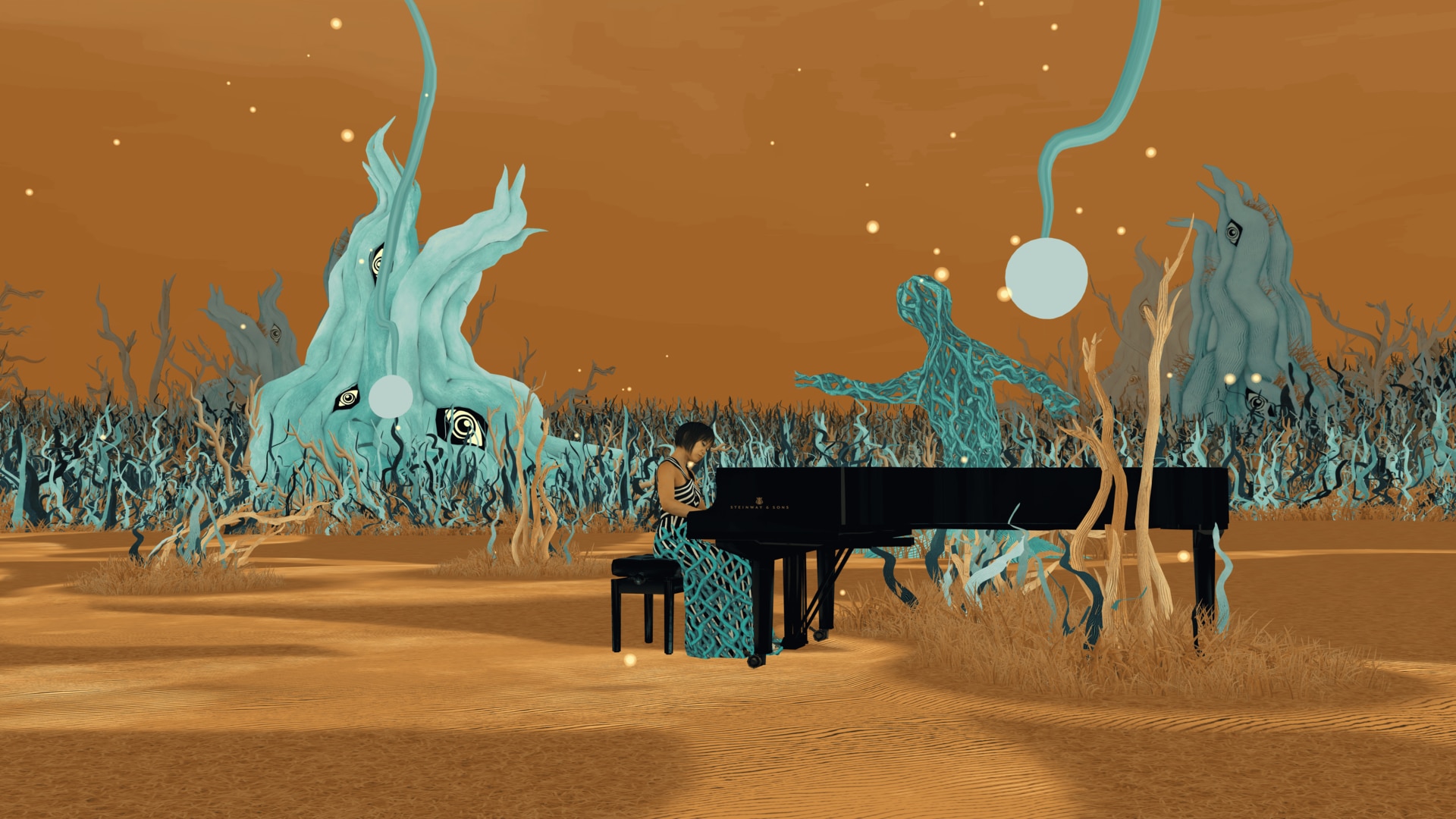
VR still, Playing with Fire: An Immersive Odyssey with Yuja Wang
You’ve spoken about Playing with Fire as a story of humanity told through music. Can you take us through the works in repertoire and the narrative you are telling throughout the experience?
You start underwater with Ravel Jeux d’eau, then you go into the land (Debussy, Bruyères), then up in the air with Stravinsky’s Firebird. At Bach’s Choral Prelude, we reach the highest elevation: the divine. The idea of God that humans somehow made a reality through building cathedrals. After this, you have Feux Follets by Liszt: the devil, who burns down the cathedral and brings you to this question which is very recent in our human history: does God exist or not?
Clair de lune (Debussy) is an in-between where you’re in a world that seems very calm and full of beauty, but that modulates in a minor key. There’s an anxiety that starts to show. The poem by Verlaine that inspired Debussy speaks about people wearing masks, and singing “in a minor key”. Perhaps the masks we wear to temporarily forget that we're going to die. It’s this happiness full of nostalgia because we know it’s not going to last. So there is this duality, a deep joy and a worry in the music of Clair de lune that you feel very deeply.
Then this worry is fully expressed in the War Sonata. Prokofiev wrote this piece after the Second World War. The people who thought of themselves as the most advanced and civilized—Europeans in the 20th century—also committed the most atrocious crimes ever in history. The progress of humanity can lead to the most beautiful things, like the music we hear, but also the worst things you could ever imagine. Prokofiev’s music expresses this contradiction.
After the War Sonata, we end with a lullaby by Brahms—one of the last pieces he wrote. Brahms said he wrote a lullaby for depressed parents. There’s hope, even if the hope can be quite bitter. So we finish the journey in the womb, in the deep waters again, with a new beginning. Then we go out of the masks we put on, the virtual-reality headsets, and we end with a Chopin waltz. We take the headset off and dance together after sharing this human journey that I hope everyone can relate to, consciously or not.
There’s something powerful to me about Yuja Wang embodying this journey as a Chinese woman performing a so-called “European” repertoire. That’s something I love about Yuja—she defies every conception we have of classical music. It is often seen as Eurocentric, white, male music. She’s the best pianist the world has ever had, and she’s a Chinese woman. That’s a new beginning. She tours the whole world to very diverse audiences. It shows that the music she plays, which we represent as very Eurocentric, is not at all. Debussy uses pentatonic chords in Bruyères that come from gamelan. It’s as much Asian as European. It’s human. I hope the whole project can represent this shared humanity—that it can speak to everyone.
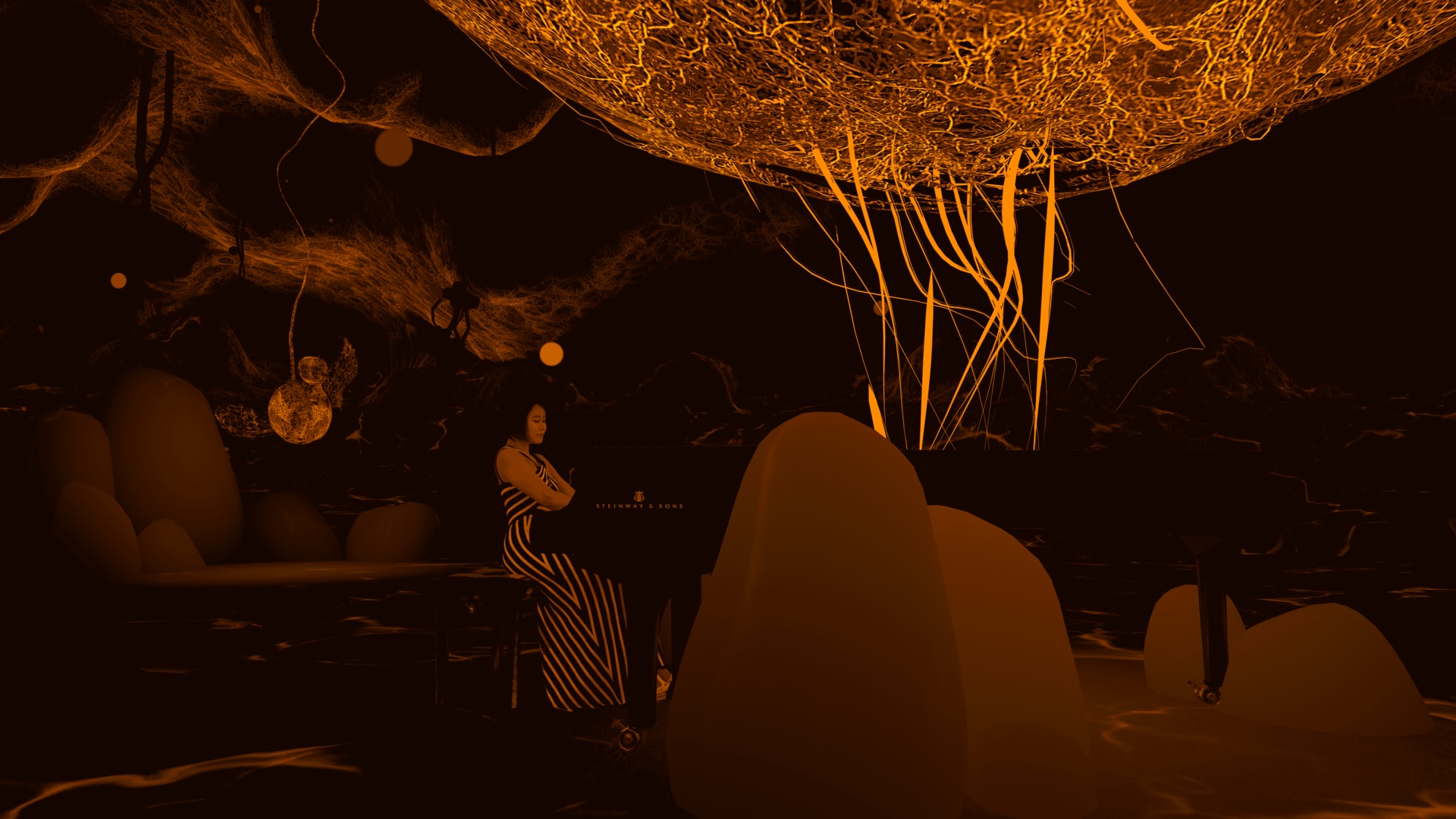
VR still, Playing with Fire: An Immersive Odyssey with Yuja Wang.
Can you talk a little more about the wider historical context for the repertoire you selected with Yuja?
The late 18th and early 19th centuries were a time when people began to question the existence of God, so artists were allowed to express something other than the will of God or the will of the king. The French Revolution, coupled with the Industrial Revolution in England, was both a political and philosophical revolution. Humanity moved forward.
Music and sound changed technically during that period too. The piano didn’t exist before this. You had the harpsichord with no dynamics. The piano was the first instrument where you could play any kind of music. You could have an orchestra in your home. The piano was also a technical revolution in how people composed as a result of what it could express in terms of dynamics and the kind of music you could create.
This project extends your long collaboration with the Icelandic visual artist Gabríela Friðriksdóttir. What has the process been like to develop the visual environments around the music with her?
I didn’t want to illustrate too much, but I wanted to give a sense of the human story we’re telling through music. When you don’t know classical music, you need to learn about it to appreciate it. I thought, how can we show it and create a journey that could open this to a new audience, or an audience that doesn’t listen to classical music at all? Show it in a compelling way visually that would make you feel it differently, somehow understand the music better, and maybe at the end make people who don’t listen to classical music want to listen to these pieces and learn more. And for audiences who are really familiar with the music, they can also have an experience that they wouldn’t have in a normal concert.We tried to design a journey where it can be compelling for anyone, regardless of what you know of classical music.
I’ve been working with Gabríela since 2007. We’ve done many projects together where we always start from an idea, maybe a line, something Gabríela would write, then she’ll do drawings. We’ve found a way to develop animation projects together in a very intuitive way. We don’t even have to speak much anymore—we understand each other really quickly after working together so much. Gabríela’s work has always involved creating human forms that reflect the elements. So it was somehow logical that I would work with her to build the visual worlds. We started from the story and worlds I composed from the pieces we chose with Yuja, then Gabríela and I together chose visual ideas, colors, shapes to express that story. She did drawings that I adapted. It was like a conversation in drawing to create the worlds. Those drawings were then translated into 3D by Arthur Maugendre (the art director at Studio Albyon). There was then a lot of back and forth between Arthur and I—“more like this, more like that.” The animations and 3D models were made in Maya and other specific development tools. Everything was then put together and edited in Unity.
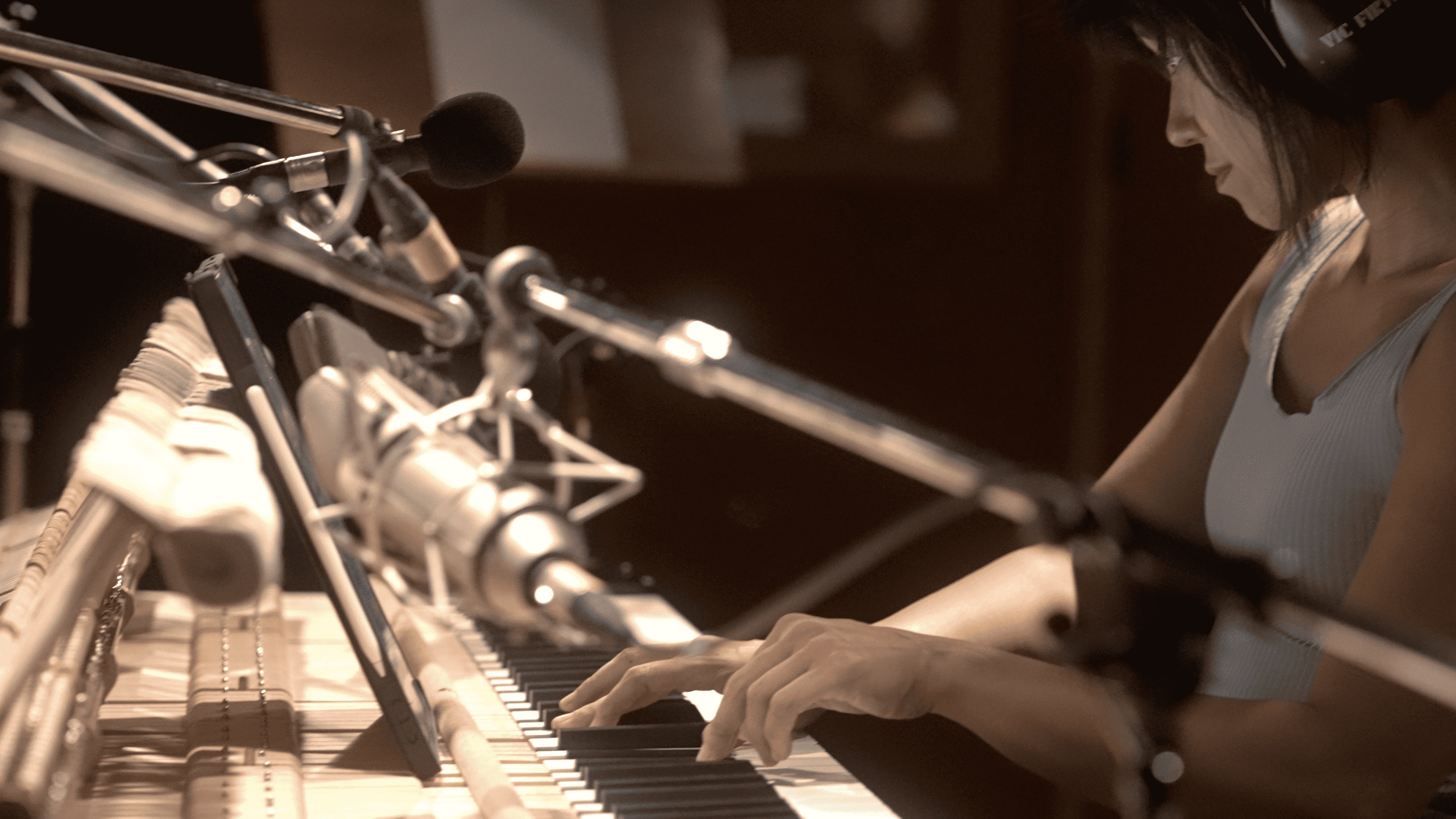
Behind the scenes of Playing with Fire: An Immersive Odyssey with Yuja Wang.
Music and sound are at the heart of this experience. How did you and sound designer Nicolas Becker approach translating the traditional recital, usually experienced by an audience member from a fixed position, into a more spatial experience where the audience can roam freely?
From the beginning, I knew I wanted to work with Nicolas Becker with whom I worked on all my other immersive projects. He is a great sound anthropologist and composer, who knows like no one else how to assemble sound universes that feel very organic. He introduced me to Antoine Martin, his collaborator who co-designed the sound with him. Antoine is also a great sound artist and has a lot of experience using AI in sound. Together, they created soundscapes for the experience that bring the visuals to life. Without those soundscapes, the visual worlds would be very dry and disconnected to the music. Their work really brings the whole show together.
Let’s talk about the mixed reality format for the installation. How do you think this new form of performance changes the relationship between audiences and the music?
The way you can dive into the world of the music and the performance is quite different. I’ve never tried this before, so I’m excited to see how audiences respond. All the projects I’ve done are never just virtual—there are always real elements. That’s why I brought together this creative team for Playing with Fire. Laurence Fontaine created the scenography—she works on big exhibitions for the Centre Pompidou amongst other cultural institutions. Gabríela makes drawings, but she also creates films, exhibitions and sculptures. As well as the original artwork at the base of the visual worlds, Gabríela designed and built the real tree sculpture at the centre of the installation. Philippe Berthomé designed the glass lamps hanging in the gallery, which also feature in the virtual space. The tree and the glass lamps act as anchors between the virtual and real environments in the experience.
And the piano, of course, is at the center of it all. The relationship you have with the presence of Yuja and the piano in virtual reality is very different when there is a real piano that you can see and hear in the physical gallery at the same time. The virtual feels much more real when you have a physical relationship with the space around you, here both visual and through sound. We have a real (Steinway Spirio) piano that plays Yuja’s performance without her being physically present. The sound quality is incredibly good. It enables us to create an intimacy with the piano and to Yuja’s performance. Of course, you can never replace being there at a live concert, but you can’t physically be that close to the piano in a concert hall. You can roam around and walk freely in the experience, you can choose the distance between yourself and the performer. That’s impossible to do in a traditional concert. Lots of the repertoire Yuja plays is maybe not easy for many people to listen to. So this mixed reality format creates that openness and access for audiences. I think “classical music” is a misnomer—there are so many different worlds within it. It’s so rich and diverse and often unconventional, that the word ‘classical’ feels way too narrow.
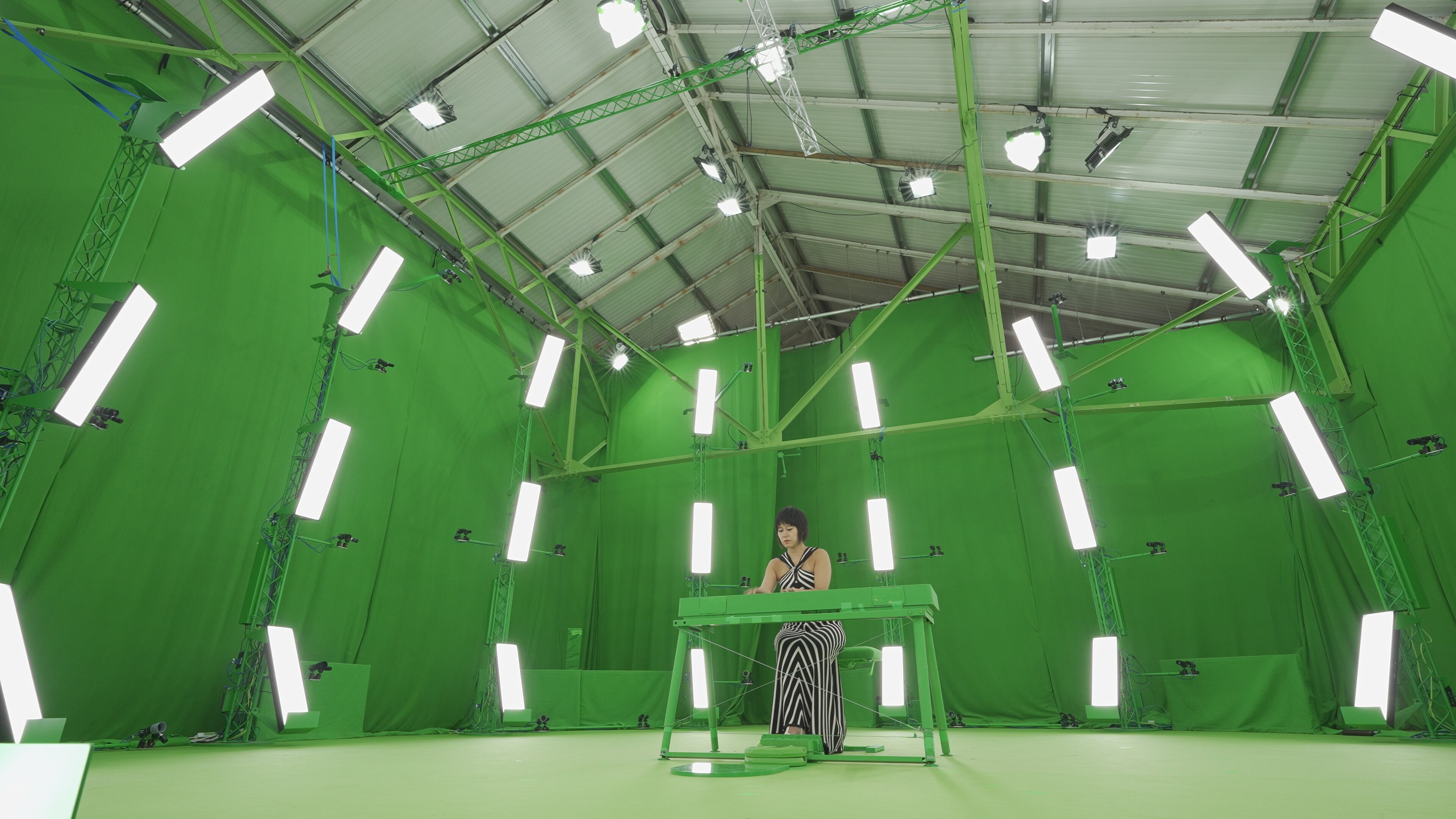
Behind the scenes of Playing with Fire: An Immersive Odyssey with Yuja Wang.
Where have been the unexpected moments and curveballs? What do you feel have been the knottiest challenges to resolve—technical or artistic or both, as these are so entangled in immersive work?
Firstly, capturing Yuja’s performance. There’s always an exchange between what we can achieve technically at this moment and the artistic vision. We tried different techniques for the capture during the R&D phase—markerless and marker-based motion capture. But it was too difficult to accurately capture her performance this way. The fact that motion capture didn’t work meant we had to use volumetric capture. We did the volumetric capture with Yuja in Grenoble at 4Dviews in May 2025, eight months after the Lightroom shoot for the Steinway Spirio recordings. At the time, I wondered if it was going to be possible to have Yuja play on top of her recorded performances. But of course, she’s so good it was no problem at all for her! I think this project shows a step forward in the technical quality of volumetric capture too. The virtual performance and the Steinway Spirio piano playback are completely in sync.
I’d love the transition between real and virtual to be more organic. That’s a limitation we currently have, and I’m sure in one or two years it won’t be there anymore. I’d be interested to make a version where you could see the real piano all the time throughout the virtual experience. For now, the way around it is to anchor points with the lamps and create correspondence between the virtual and real that makes you forget about the transition. But this could be finessed—it’s a technical limit. Limitations do give you more ideas creatively.
You never know where you’re going in an artistic project. It’s through the experience of doing it that you find the way forward. As I said, I started as an engineer, so I try to see where we can push the technical limits. It’s always a dialogue between the tools and the way you use them, bend them, move them around to make it work. A brush or a pen is the same thing as a line of code. It’s a tool that you have to use well. You can do the best or the worst thing with tools. It’s just the way you use them for your ideas.
Playing with Fire: An Immersive Odyssey with Yuja Wang is on view at the Musée de la musique – Philharmonie de Paris from 14 November 2025 to 3 May 2026.